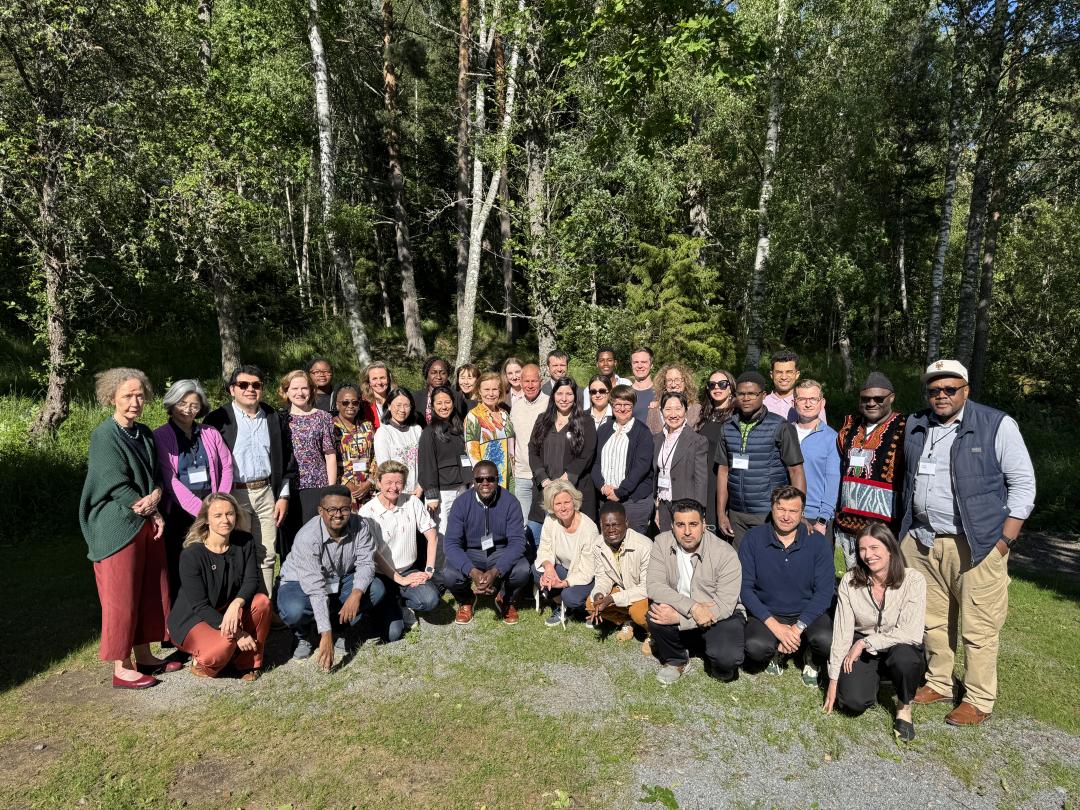
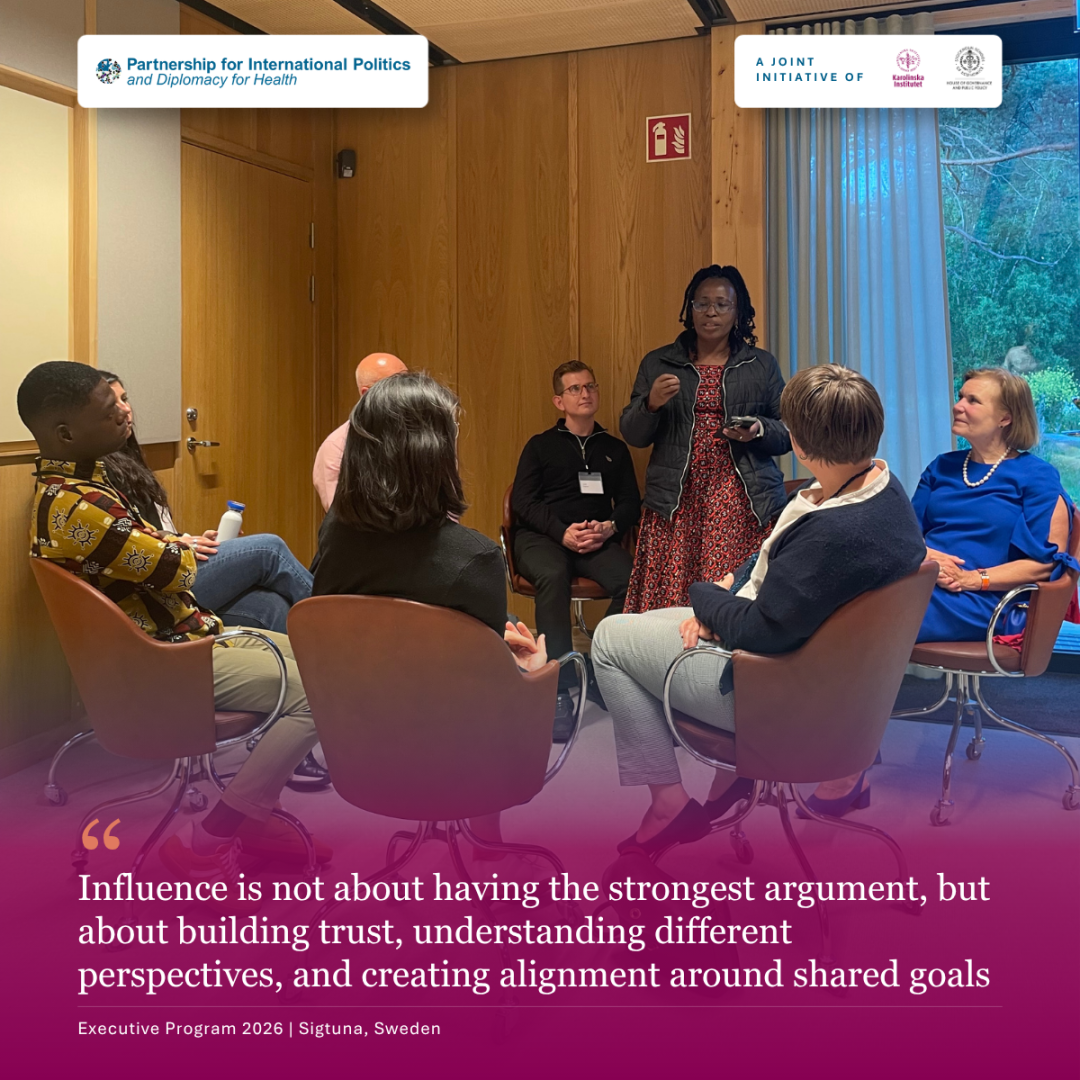
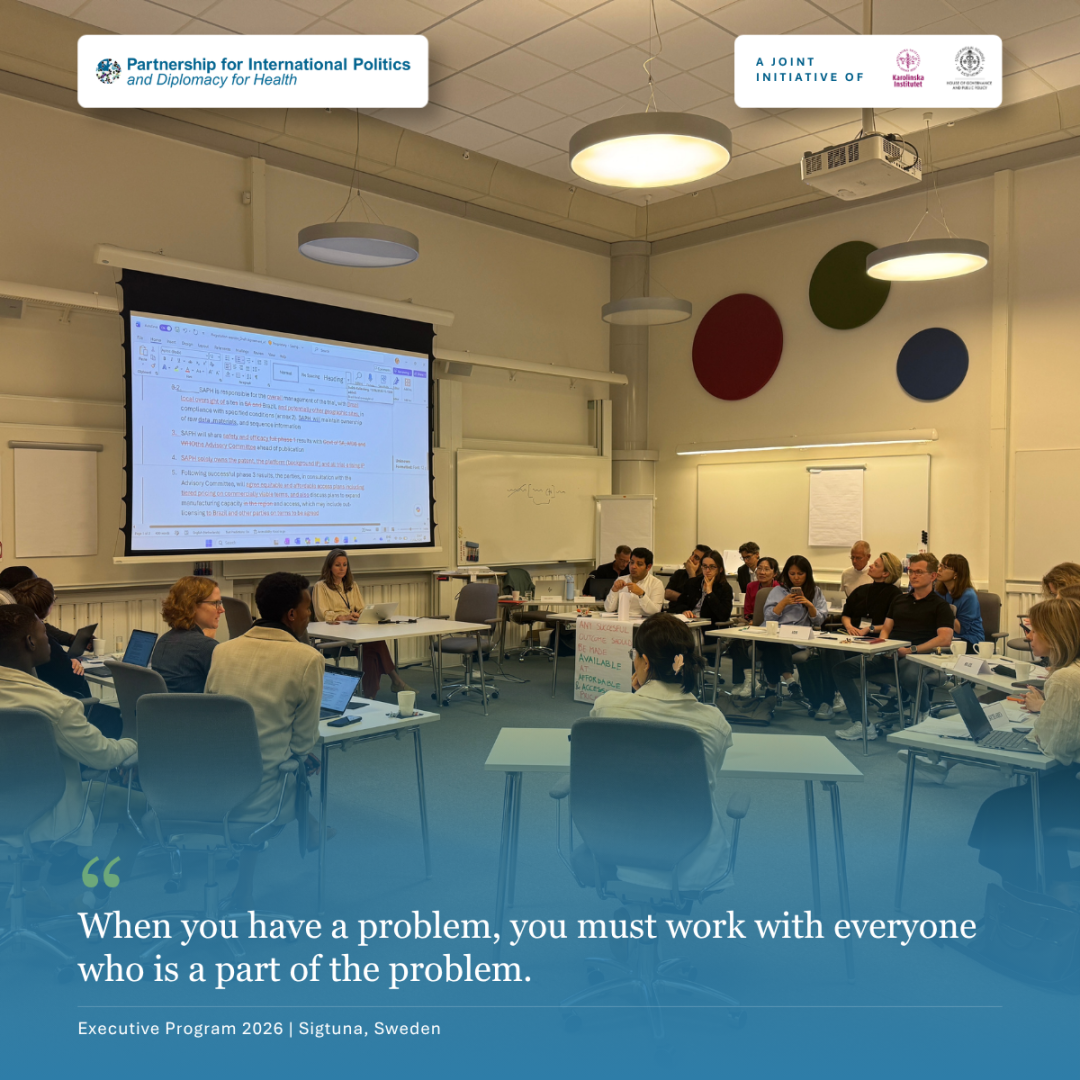
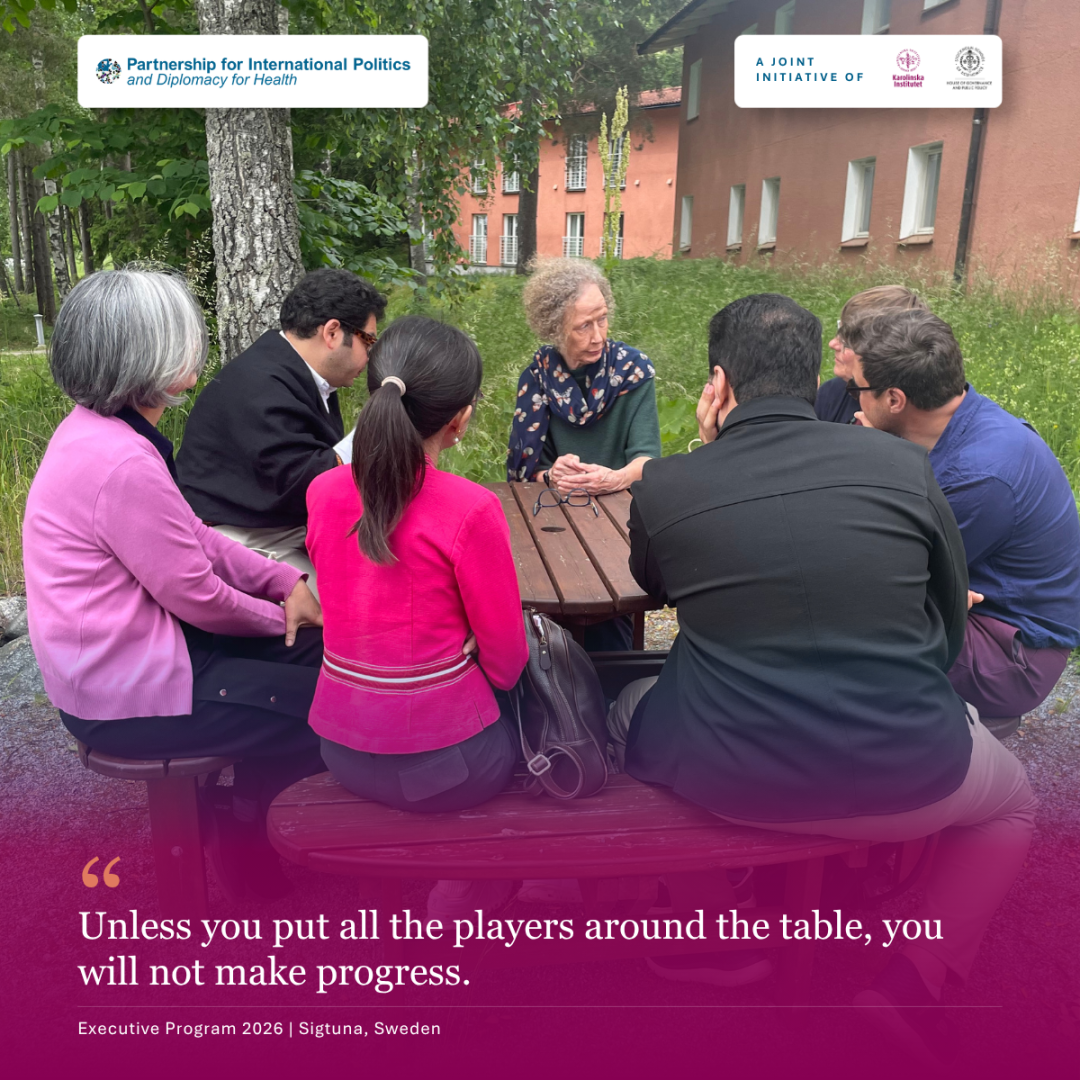
2026 Year’s Program

Karolinska Institutet and the Stockholm School of Economics has just launched the call for nomination for the 2026 year’s International Politics and Diplomacy for Health for Emerging Leaders Executive Program.

The program comprises of five online workshops, and a five-day masterclass in Sweden. We deliver the program around a practitioner-to-practitioner model rather than traditional teaching - bringing some of the most experienced leaders in the global health sphere together with the course participants.

The program is built on the sharing of real present or past personal experiences from navigating in regional or global political contexts for health (including storytelling, debates and peer-to-peer learning). Participants will also be guided by relevant reading material (books and short articles) as well as existing short online video sessions and podcasts.

After completion a certificate will be issued jointly by Karolinska Institutet and the Stockholm School of Economics. 

The participants will be part of a growing network of colleagues, the Health Diplomacy Community. A web platform will be established to support communication and exchange as well as recurrent events and seminars. Read more about the global network.

Learning objectives

The Executive Program is designed to cover six  dimensions of and competences for health diplomacy:

  1. The dynamics of formal and informal decision-making – where and by whom are real decisions taken?
  2. Fostering trust, building networks, and nurturing relationships – how to do it?
  3. Transformative leadership – how to identify and maximize/seize windows of opportunity?
  4. Understanding and learning from entrepreneurship and the private sector.
  5. Managing uncertainty and coping with failures – embracing failure, being courageous, and understanding oneself and one’s adversaries.
  6. Effective communication – why do style, language, and timing matter? 

Across these six dimensions, the cross-cutting theme of passion and clear personal values will also be present.  

Participant Profile and Eligibility Criteria

The program enrolls up to 28 mid-career professionals from all regions of the world and will have a geographically representative and gender-balanced mix of participants from the public and private sectors and civil society.

As an Executive Program, we are looking for participants with the following qualifications:

  • specific experience from having managed or contributed to political processes of relevance to health at regional or global level.
  • 10-15 years of senior relevant and professional working experience from either public or private sector, civil society and international organisations and foundations.
  • proven commitment to and knowledge about health trends and improvements.
  • excellent knowledge about the international system of relevance to health.
  • strong motivation for how this program will contribute to their continued career development, and ability to meet the required time commitment.

Program timeline

The workshops will take place between April - July 2026 and run for 2 hours each (13.00 -15.00 CET).

The masterclass will be in person only and take place close to Stockholm and start at Monday lunch and finish Friday lunch (8-12 June 2026).

Nomination and application process

Applications to the Executive Program in Global Health Diplomacy are accepted by nomination only. Senior colleagues and leaders within relevant organizations has been invited to nominate potential fellows who meet the program’s criteria. The call for nominations is open from 3 November until 3 December 2025.

Direct applications from individuals will not be considered. Once nominations have been received, selected candidates who fulfill the eligibility requirements will be invited to submit a full application (10 December 2025 – 15 January 2026). The nomination form and further instructions will be provided to invited nominators during the nomination period.

For more information or questions please contact Erik Pettersson at Karolinska Institutet erik.pettersson.2@ki.se

Cost

The program participation fee is SEK 115,000 (approximately USD 12,000). 

  • Participants from high-income countries working in public sector and in civil society can if needed receive a discounted rate of SEK 19,000 (approximately USD 2,000).
  • Participants from low- and middle-income countries (LMICs) will receive a discounted rate of USD SEK 9,500 (approximately USD 1,000).
  • Participants from private foundations and international organisations are kindly asked to pay the full fee as a way of also supporting the program as a whole.

The fee includes all costs for the in-person masterclass (accommodation, meals, etc.). Travel costs are not included in the fee.

Participation must be supported by and come through a legal entity - an organisation, company or the equivalent. Private payment from individuals is unfortunately not possible. The organisation (e.g. the employer) supporting the participant must be specified on the application form.

The Executive Program is offered as contract education, in accordance with the Ordinance (SFS 2002:760) on Contract Education at Universities and University Colleges, and the Swedish National Agency for Higher Education's directions for Contract Education at Universities and University Colleges (HSVFS 2003:3).

Program management

The program will be coordinated and managed by the House of Governance and Public Policy at the Stockholm School of Economics, in collaboration with the Department of Global Health at Karolinska Institutet. 

The program is managed by a team consisting of: 

Anders Nordström, Program Director
Karolinska Institutet and Stockholm School of Economics 

Gunilla Carlsson, Program Co-Director 
Karolinska Institutet and Stockholm School of Economics 

Martin Jeppsson/Clara Luthman, Program Coordinator and Manager
Karolinska Institutet 

Karl Wennberg, Professor
Stockholm School of Economics 

Tobias Alfvén, Professor
Karolinska Institutet 

Anna-Lee Cöster Jansén, Administrative Assistant
Karolinska Institutet