


Reforming WHO: Five Considerations for the Next Director General
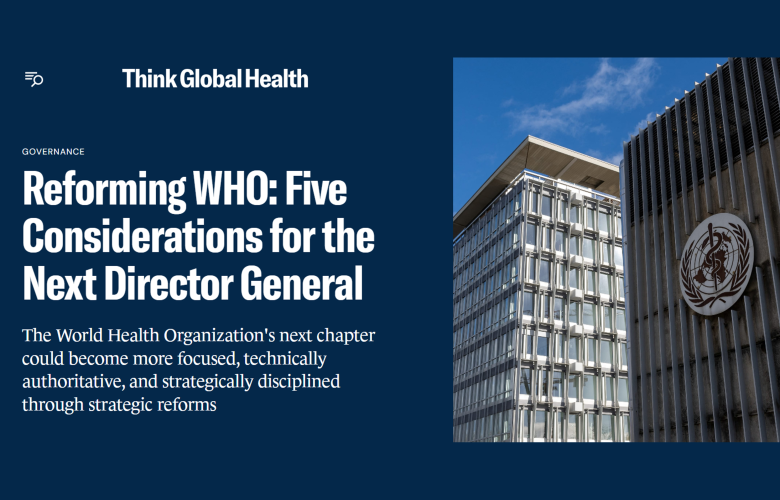
In a new opinion piece published in Think Global Health, Anders Nordström argues the need for structural and institutional reform of WHO centering around five specific considerations.
1) Major changes in the use of AI and human resource policies, performance management, and organizational culture to reclaim trust and becoming unquestionably excellent at what WHO is uniquely positioned to do.
2) Introducing single and nonrenewable terms for the WHO Director-General,
3) Regional committees not to maintain the current level of political power. Regional Directors to be appointed by the Director-General through open international recruitment processes instead of through regional elections,
4) Substantially reforming governance with a particular focus on the Executive Board making it Executive again and not a mini-WHA, and
5) Fundamentally changing WHO’s financing model only accepting unearmarked resources.
The world now needs a different WHO: more focused, more technically authoritative, more independent, more modern, and more strategically disciplined.
The Accra Reset and the WHO-hosted joint process have potentially important implications for the trajectory of reforms of the international system for health. Both processes are promising and should be supported to promote the delivery of bold and actionable reform proposals. However, neither of them aims to specifically address reforms of WHO.
WHO's role, functions, and mandates must not be left out in the ongoing reform discussions. The organisation still matters enormously to the global health ecosystem. But short of deep and real reform, WHO risks gradually losing the role the world still needs it to play.